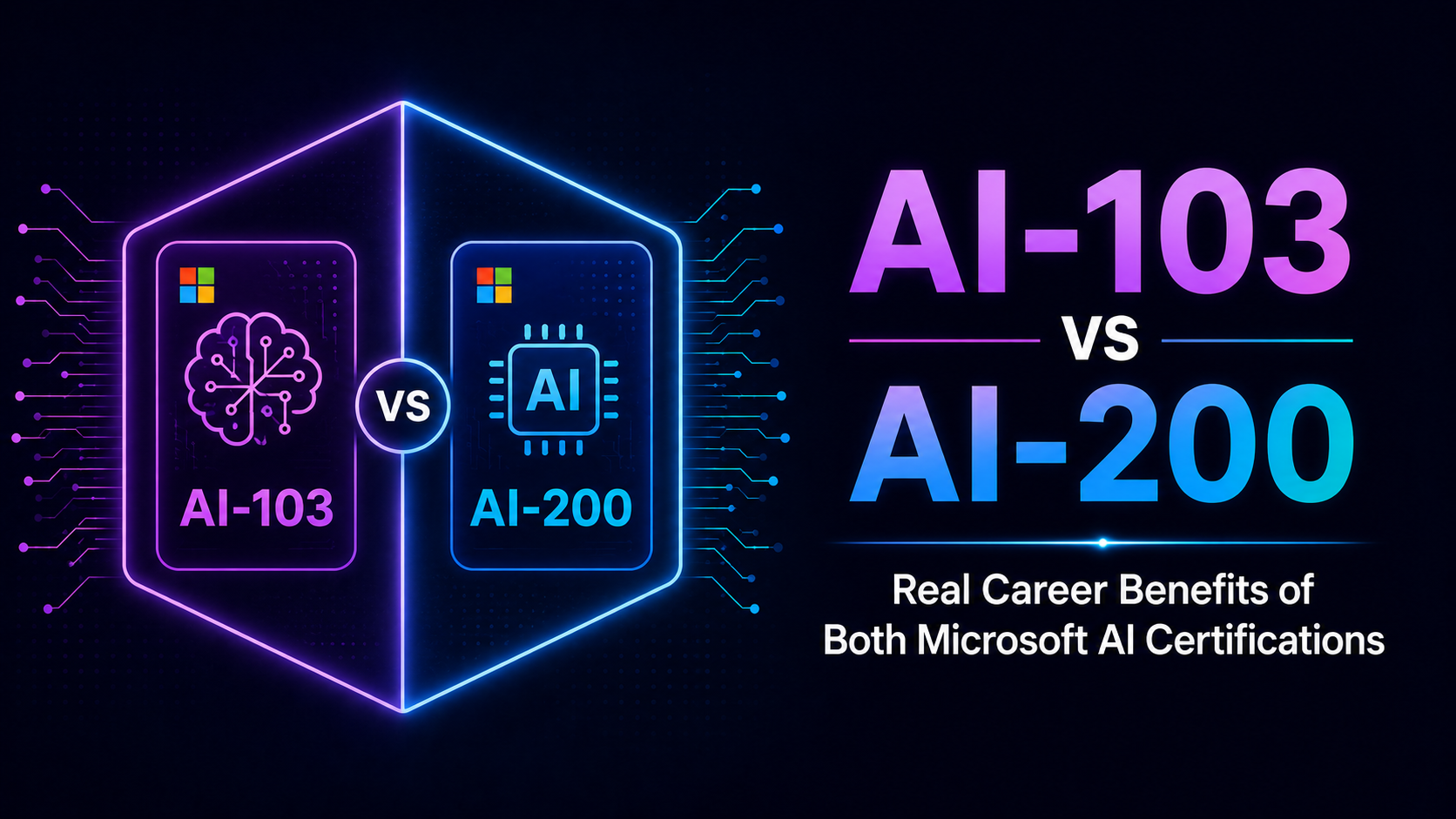
Microsoft’s AI certification process will change in 2026, and two more recent exams are receiving focus: AI-103 and AI-200. Both exams focus upon Azure AI, however they offer different career paths.
AI-103 is linked to AI-103 is part of the Azure AI Apps and Agents Developer Associate route. It validates the ability of developing, designing and deploying sophisticated Azure AI solutions using Python and Microsoft Foundry.
AI-200 is connected to it’s Azure AI Cloud Developer Associate path. It focuses on developing and building AI solutions using Azure using back-end service, flexible architectures and the complete development lifecycle.
The Main Difference in Simple Words
AI-103 is the best choice if would like to create AI applications and dynamic AI solutions, or ready-to-use agents using Microsoft Foundry.
AI-200 is the best choice if are looking to create the cloud-based foundation for AI solutions, which includes back-end computing, compute APIs, security monitoring, and deployment.
Read More: Common Mistakes to Avoid in a Biology Assignment
Therefore AI-103 is focusing more upon AI applications and agents. AI-200 is more centered upon AI cloud creation and support for architecture.
AI-103 vs AI-200 Quick Comparison
| Area | AI-103 | AI-200 |
| The path to certification | Azure AI Apps and Agents Developer Associate | Azure AI Cloud Developer Associate |
| Principal goal | AI apps, agents, Python, Microsoft Foundry | Microsoft back-end AI services and cloud-based development |
| Best for | Artificial Intelligence engineers, developers and are building agents | Cloud developers developing large-scale AI solutions |
| Core skill set | Generative AI, agents, AI app deployment | APIs, compute, security, monitoring, deployment |
| Focus on the product | Azure and Microsoft Foundry | Azure |
| Career direction | AI app developer, AI agent developer | AI cloud developer, Azure AI developer |
What AI-103 Offers for Your Career
AI-103 is a great course for developers who wish to directly work with modern AI applications. Microsoft states that the AI-103 course is specifically designed to help software engineers build, manage and implement AI solutions with Microsoft Foundry, Python, APIs and SDKs.
This helps to make AI-103 ideal for those who are looking to collaborate with:
- AI agents
- Generative AI applications
- Microsoft Foundry
- AI solutions that use Python
- Azure AI services
- Agent deployment
- AI application design
The main benefit to you as a professional is that AI-103 is in close contact with how companies are employing AI. Companies want chat-based tools robots, intelligent assistants and AI applications that address actual issues. AI-103 lets candidates demonstrate that they are able to create solutions.
What AI-200 Offers for Your Career
AI-200 is more focused on cloud-based development. The AI-200 study guide from Microsoft states that applicants contribute to all stages of the implementation of AI solutions in Azure such as the gathering of requirements development, design deployment, security and monitoring.
AI-200 is a great tool for those who wish to build on the technology that underlies AI systems. It’s not just about creating the AI feature. It’s about making sure that the feature runs properly it is properly scaled, has a good connection to Azure service, and is able to be monitored in the production.
AI-200 may help candidates advance into roles that include:
- Azure AI Cloud Developer
- AI Backend Developer
- Cloud Application Developer
- Azure Solutions Developer
- AI Implementation Engineer
Which Certification Is Better for AI Agents?
AI-103 is the most suitable option to use AI agents. Microsoft’s certification update page outlines how to go about the Azure AI App along with the the Agent Developer Associate paths as focusing on developing generative software and managing AI resources within Microsoft Foundry and creating ready-for-production AI agents.
If you are looking to create solutions based on agents, AI chat experiences, dynamic applications and Microsoft Foundry projects, AI-103 is the more straightforward choice.
Read More: Writing Nursing Assignment on Legal Accountability and Ethics
AI-200 can still aid as agents require cloud infrastructure APIs, security, and monitoring. However, AI-103 is more focused on the role of building agents itself.
Which Certification Is Better for Cloud Developers?
AI-200 is a better choice to cloud-based developers. It is focused on Azure compute containers, Containerization Patterns, Serverless APIs Azure Functions Event-driven Architecture, Azure Service Bus, and Event Grid.
This is vital because a large number of AI solutions fail because cloud architecture is not strong. AI systems require APIs that are reliable and secure access, as well as good monitors, and scalable web hosting and a seamless integration with other services.
If you are already working with Azure creation, AI-200 may feel like the natural next step.
Which One Should Beginners Choose?
Beginners should make their choice according to their existing capabilities.
If you are already familiar with Python and would like to develop an generative AI applications, AI-103 would be a good option. If you are familiar with Azure development and are looking to help support AI solutions using cloud services, AI 200 is the better choice.
Complete beginners shouldn’t jump straight into either test without understanding the basics. Learn:
- Azure basics
- Python fundamentals
- APIs and SDKs
- Cloud application concepts
- AI fundamentals
- Basics of security and monitoring
Then, select AI-103 to develop AI agents and applications or AI-200 for cloud-based AI development.
Skills That Overlap Between AI-103 and AI-200
Both certifications can be used to support Azure AI careers, so they share a few common abilities. Candidates must be aware of Azure Services, AI solution design, deployment thinking, security fundamentals as well as real-world business instances.
The difference lies in the depth and direction. AI-103 is a deeper dive into AI agent and application development. AI-200 delve deeper into the back-end including development lifecycles, as well as cloud deployment.
This is a great opportunity to use both options if your aim is to be a better Azure AI professional.
Best Study Path for AI-103
Begin by learning Python along with Azure AI fundamentals. Then, you can learn Microsoft Foundry, APIs, SDKs, development of agents, and Agenerative AI app design.
An easy AI-103 route looks like this:
- Learn Python fundamentals
- Review Azure AI services
- Study Microsoft Foundry
- Practice building generative AI apps
- Learn about the design of agents and their deployment
- Review security and monitor
- Practice exam-style questions
For final revision, students may utilize certempire.com once to check the level of exam readiness after studying the official Microsoft learning resources and creating projects that require hands-on work.
Best Study Path for AI-200
Begin with Azure development fundamentals. Discover the ways Azure Functions, compute, containers APIs, messaging event-driven systems, as well as monitoring can support AI applications.
An easy AI-200 path is as follows:
- Review Azure development fundamentals
- Explore compute and hosting alternatives
- Learn about serverless APIs
- Learn about the event-driven architecture
- Practice integrating Azure services
- Examine security, deployment and monitoring
- Review AI Lifecycle of a solution topics
AI-200 is a great choice for those who want to build AI systems that work for production and not just for demos.
Final Verdict
Select AI-103 If you are looking for AI applications that are the generative AI, Microsoft Foundry, Python-based development and manufacturing-ready AI agents.
Select AI-200 to achieve Azure AI cloud application development Back-end support, flexible architecture APIs deployment, security and monitoring.
For a long-term career advancement, AI-103 is better for those who wish to be closer to AI development of products. AI-200 is best for those who wish to develop and help support the Azure cloud-based systems that power AI solutions. Together, they can build the necessary skills needed to be able to compete in the current Microsoft AI careers.
About the Author